 ZH
ZH  RU
RU  EN
EN 
Altai State Museum of Local Lore
Addresses
- 28 Krasnoarmeysky Avenue, Barnaul, Altai Krai (Permanent Exhibition)
- 39 Polzunova Street (Exhibition Venue)
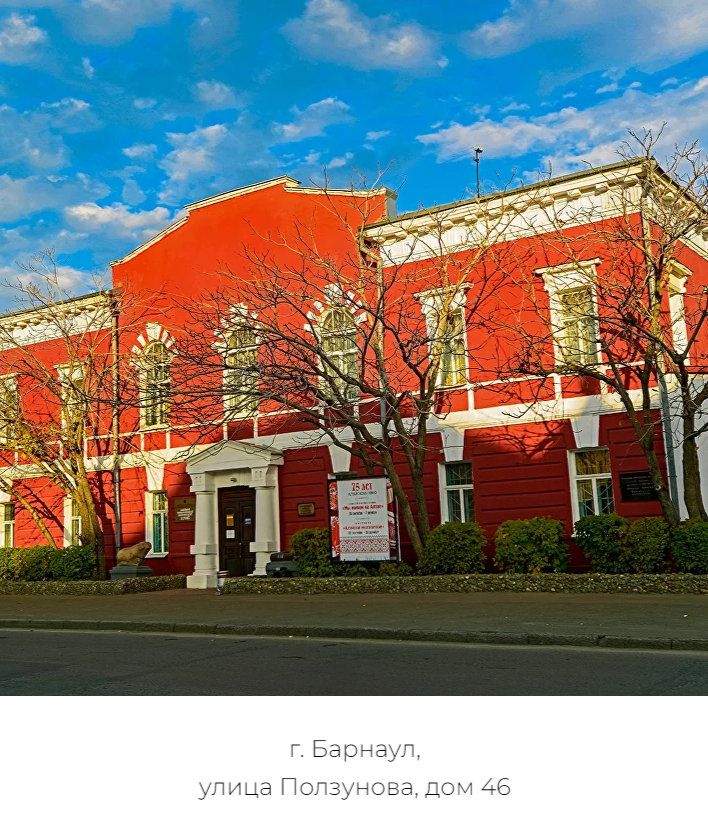
- 46 Polzunova Street & 73b Komsomolsky Avenue (Under Restoration)
Contact Phone
+7 (3852) 20-51-49
Official Website
Opening Hours
1. Permanent Exhibition (28 Krasnoarmeysky Avenue)
- Mon, Tue: Closed
- Wed–Sun: 9:30 AM – 5:30 PM (Ticket office closes at 5:00 PM)
- Thu: 11:00 AM – 7:00 PM (Ticket office closes at 6:30 PM)
- Last Friday of the month: Cleaning Day (Closed to visitors)
2. Exhibition Venue (39 Polzunova Street)
- Mon, Tue: Closed
- Wed–Sun: 11:00 AM – 7:00 PM (Ticket office closes at 6:30 PM)
- Last Friday of the month: Cleaning Day (Closed to visitors)





📍Посмотреть на карте
[ ▶︎ ] Video Review
Brief historical background, collections and exhibitions of the museum
The Altai State Museum of Local Lore is one of the first in the Siberian region. It was founded in 1823 on the initiative of P.K. Frolov (1775–1839), the head of the Kolyvan-Voskresensk factories district and civil governor of Tomsk, with the direct participation of F.V. Gebler (1781–1850), a physician and researcher of Altai. The founding commemorated the 100th anniversary of the beginning of the mining industry in Altai.
Since its creation, the museum has been visited by famous scientists, travelers, and cultural figures, including: C. Ledebour, A. von Humboldt, P.P. Semenov-Tyan-Shansky, A. Brehm, N.M. Yadrintsev, cosmonauts G.S. Titov and G.M. Grechko, poet E.A. Dolmatovsky, famous TV presenter Yu.A. Senkevich, actor and director N.N. Gubenko, and many others.
The museum's collection includes over 200,000 items. It is based on unique collections: Mineralogical, Historical-Technical, Archaeological, Ethnographic, and "Rare Book."
The Historical-Technical collection is one of the most valuable. It includes models and original objects related to the history of mining and metallurgical technology in Altai in the 18th–19th centuries. Many of them have no analogues in other museums in the country. The collection was initiated by P.K. Frolov. Today, the museum's holdings include five exhibits created in the 1820s. The most famous is a model of I.I. Polzunov's steam-atmospheric machine with a blowing unit, made in 1825. Unique exhibits include two sets of dies for minting copper coins of all denominations: the Siberian and the all-Russian type of the 1830s. A standout item in the museum's collection is a pharmacy bowl made at the Kolyvan Polishing Factory in 1815 for the Barnaul Pharmacy. Currently, 34 items from the Historical-Technical collection have been recognized as monuments of science and technology of national significance by the Expert Council "Monuments of Science and Technology" at the Polytechnic Museum (Moscow), on behalf of the Association of Scientific and Technical Museums of the Russian National Committee of the International Council of Museums.
The Archaeological collection contains over 15,000 exhibits (ceramics, weapons, horse harnesses, jewelry, and more) and reflects the culturogenesis and sociogenesis of Siberian societies from the Stone Age to the Middle Ages. One of the first exhibits to enter the museum was a statue of a ram from the Turkic period. The museum also holds a collection of stone statues from the Turkic period.
The Mineralogical collection is one of the oldest and includes minerals and rocks not only from Altai and Ural mines and factories but also from many European countries, as well as Greenland and South America. The pride of the museum's collection are two meteorites weighing 5 and 1.5 kg, found in the Klyuchevskoy district in 1986.
The Ethnographic collection includes over 2,500 items of material and spiritual culture of the indigenous, nomadic peoples of Siberia (Altaians, Teleuts, Kumandins) and settlers (Russians, Ukrainians, Belarusians, Germans, Chuvash, Mordvins, Tatars, Mari): costumes, jewelry, household items, tools, religious objects, and much more.
The pride of the "Rare Book" collection are unique books from the libraries of the Kolyvan-Voskresensk factories with autographs of major European researchers.
The museum is located in three buildings that are monuments of federal and regional significance.
In 2018, the museum was given the building at 39 Polzunova Street. This is a monument of federal significance, the "Instrument Shop," built in 1823–1826. It currently houses exhibition halls and part of the museum's storage. Since 2021, the main exhibitions have been relocated to 28 Krasnoarmeysky Avenue, in the "Zubov's House," a monument of regional significance built in the second half of the 19th century. The main museum building at 46 Polzunova Street is under reconstruction. The Military Museum, located in the building at 73b Komsomolsky Avenue, a monument of regional significance known as the "City Hospital" (built in the 1910s), is also currently under reconstruction.
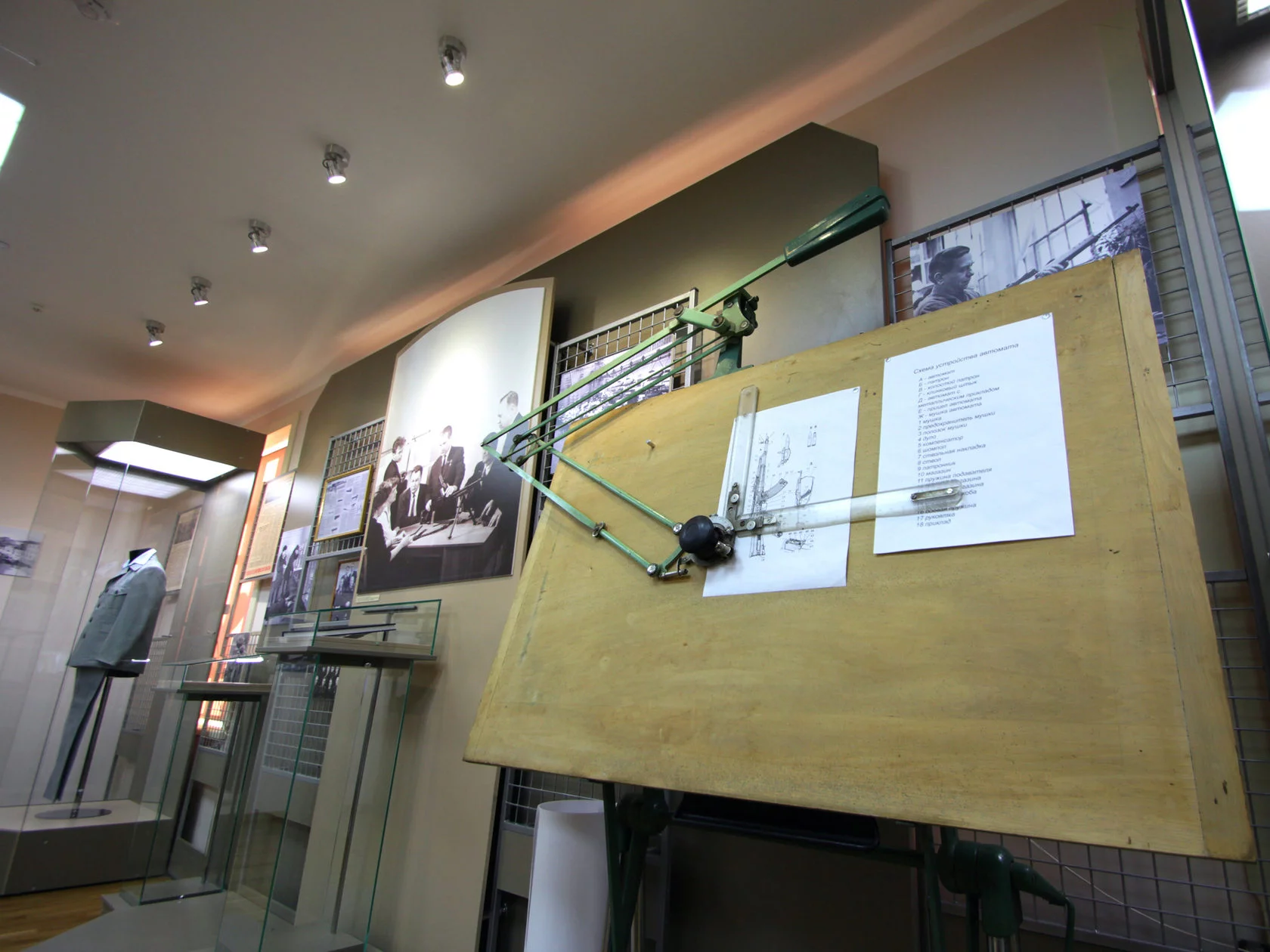
In the village of Kurya, Kuryinsky District, Altai Krai, there is a branch of the museum – the M.T. Kalashnikov Memorial Museum (opened on November 15, 2013).

